
Gas cooker not working? Safe checks before a repair
Check a malfunctioning gas cooking range safely, find its model details, recognise stop conditions and prepare a useful technician handoff.
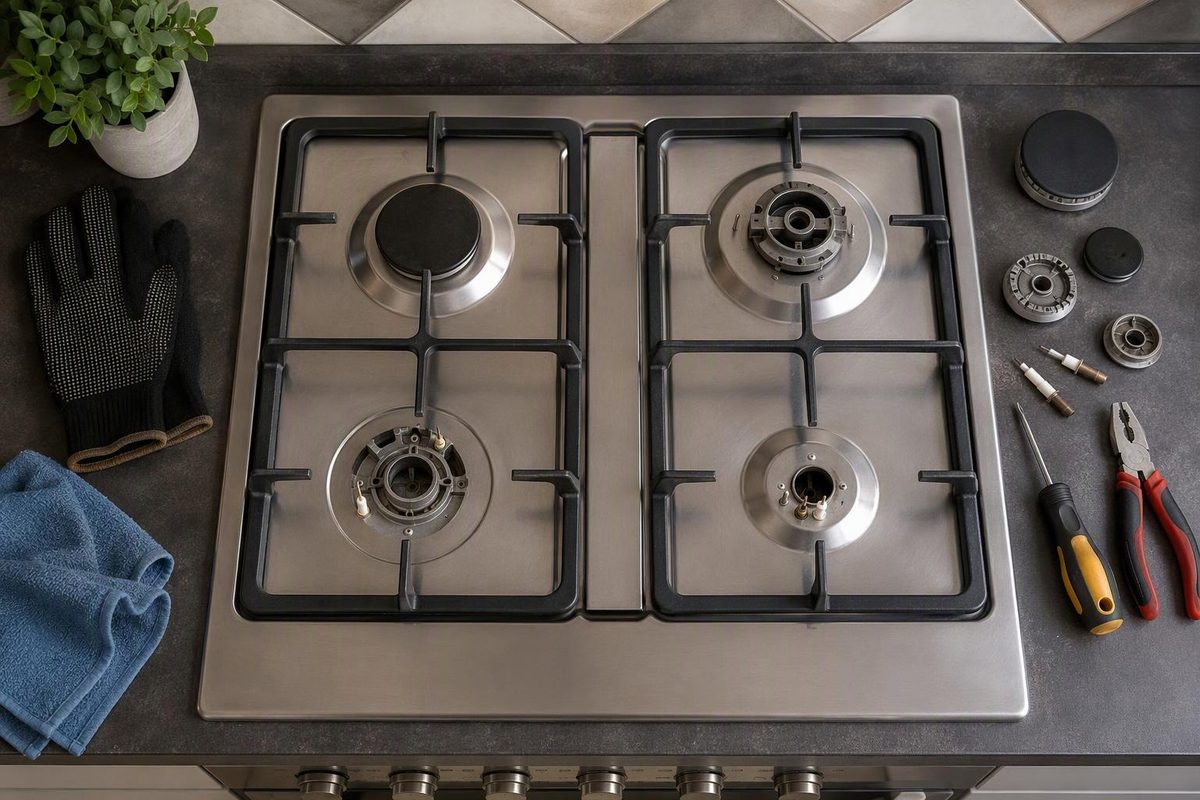
By Fix Handbook
A gas cooker that will not light may need only a dry, correctly seated burner cap—or it may need professional repair. Start by separating an emergency from a user-maintenance problem. These checks cover cooking ranges, ovens and hob burners, not freestanding gas heating stoves.
Stop first if you smell gas or suspect carbon monoxide
A suspected gas leak is not a troubleshooting task. Stop trying to ignite the cooker, get everyone outside and call the local gas emergency service from a safe location. Do not operate electrical switches, unplug the cooker, smoke or use matches. National Grid’s emergency guidance advises evacuation and avoiding anything that could create a spark.
For natural-gas emergencies, call 0800 111 999 in England, Wales and Scotland, or 0800 002 001 in Northern Ireland. LPG arrangements differ: use your supplier’s emergency contact. Follow the instructions for your location; do not turn a shut-off supply back on yourself after a suspected leak. Gas Safe Register lists the regional and fuel-specific arrangements.
If a carbon-monoxide alarm sounds or you suspect exposure, leave for fresh air and contact the gas emergency service. Seek medical advice promptly if you suspect poisoning, and do not re-enter until advised it is safe. Headache, dizziness, nausea and breathlessness can be symptoms. In the UK, call 999 for suspected exposure with difficulty breathing, sudden confusion, loss of consciousness, weakness, or chest or muscle pain; elsewhere, use the local emergency medical number. CO has no smell, so an absence of gas odour is not reassurance. See the NHS advice on symptoms and medical help and Gas Safe Register’s emergency response.
Lazy yellow/orange flames or dark, sooty staining also warrant stopping use and arranging a safety check—not adjusting the burner yourself. These are recognised warning signs.
Find the model before following repair advice
Once there is no emergency, photograph the full model and serial-number label and find the manufacturer’s manual for that exact model. Record the fuel type if known: natural gas or LPG/propane. Do not assume an oven is gas merely because the hob is gas.
Label positions vary. On GE ranges, possible accessible locations include the front frame behind the oven door and the frame inside the drawer. GE also warns that numbers on caution labels are not necessarily model numbers. Use the manufacturer’s model-label locator, rather than pulling the cooker out to search behind it.
If you cannot safely reach the label, check purchase or installation paperwork and ask manufacturer support for help.
Match the symptom to a limited check
Use observations from the malfunction; do not deliberately recreate a dangerous fault.
| What happened | Safe check | When to hand it over |
|---|---|---|
| One hob burner stopped lighting after cleaning or a spill | With the cooker off and cool, check for moisture, residue and a misplaced cap. Follow the cleaning steps below. | It still fails after cleaning, drying and correct reassembly. |
| Ignition is silent, or the display is dead | Check whether household power is out and whether the cooker’s accessible supply switch is in its normal operating position. | Household power is available but the cooker remains dead. If you suspect a supply-circuit fault, use a qualified electrician. |
| Several burners click but will not light | Turn the controls off. Check for a reported supplier outage or recent installation work; do not open connections or valves to investigate. | No simple external explanation is apparent, or the problem followed installation, reconnection or fuel conversion. |
| Hob works but oven does not heat | Check the selected mode and operating instructions for your model. Note any displayed error code. | Correct operation does not resolve it; do not remove panels or test internal components. |
Beko’s ignition guidance identifies loss of electrical power, wet burner parts, clogging and technical faults as possible causes. None of those symptoms alone identifies a failed part.
A working hob does not prove that the oven’s gas supply is correct. On some Whirlpool ranges, a separate regulator shut-off can allow gas to reach the hob but not the oven. That is useful information for the technician—not a reason to reach underneath and move levers. Whirlpool explains this distinction.
The maintenance check: clean, dry and reseat
Only proceed if there are no warning signs and the manual permits removal of the burner parts.
- Turn every control off, let the cooker cool and follow the manual’s electrical-isolation instructions before cleaning.
- Remove only the caps or heads identified as user-removable. Keep each part matched to its original burner.
- Clean using the manual’s approved method. Do not flood the ignition area or scrub delicate ignition parts aggressively.
- Let the parts dry completely. Refit the correct cap centrally and level, with the fit specified by the manufacturer.
For example, Beko’s HIG64421S manual requires electrical isolation and cooling before cleaning. Use your own model’s instructions for the method and removable parts.
Whirlpool’s burner guidance stresses correct cap matching and seating. If your manual permits clearing flame ports, use only its specified method: do not enlarge the holes or insert a wooden toothpick that could break off. Flame ports are not the gas injector; do not probe jets or supply openings.
After reassembly, restore power and make a normal lighting attempt exactly as the manual directs. If the burner does not light, turn it fully off and follow the manual’s waiting instructions. Do not keep releasing gas, improvise with a lighter or bypass a safety device. Persistent failure needs service.
Prepare the technician handoff
Do not dismantle valves, regulators, gas connections, ignition wiring or flame-failure devices. In Great Britain, anyone employed to do domestic gas work must be Gas Safe registered and competent for that area of work; check the appliance qualifications on the back of their ID card. HSE explains the requirement. Elsewhere, use an appropriately qualified service provider under local requirements.
Send the service provider:
- The model/serial photo and fuel type, if known.
- Which burner or oven function fails, and whether the display and ignition worked.
- The exact error code and any existing photos of residue or damaged parts.
- When it started: after a spill, cleaning, outage, installation or conversion.
- Which permitted checks you completed and whether they changed anything.
- Any smell, soot, unusual flame or CO alarm—and whether an emergency service attended.
Ask whether they repair that model and fuel type, what the call-out charge includes, and what checks will establish that the cooker is safe to use again. Keep a cooker you suspect is unsafe out of use until it has been checked.