
Kissing bug or look-alike? What to check before treating
Compare kissing bugs with wheel bugs, boxelder bugs, seed bugs and masked hunters. Learn how to collect a suspect insect safely and get identification help.
By Fix Handbook
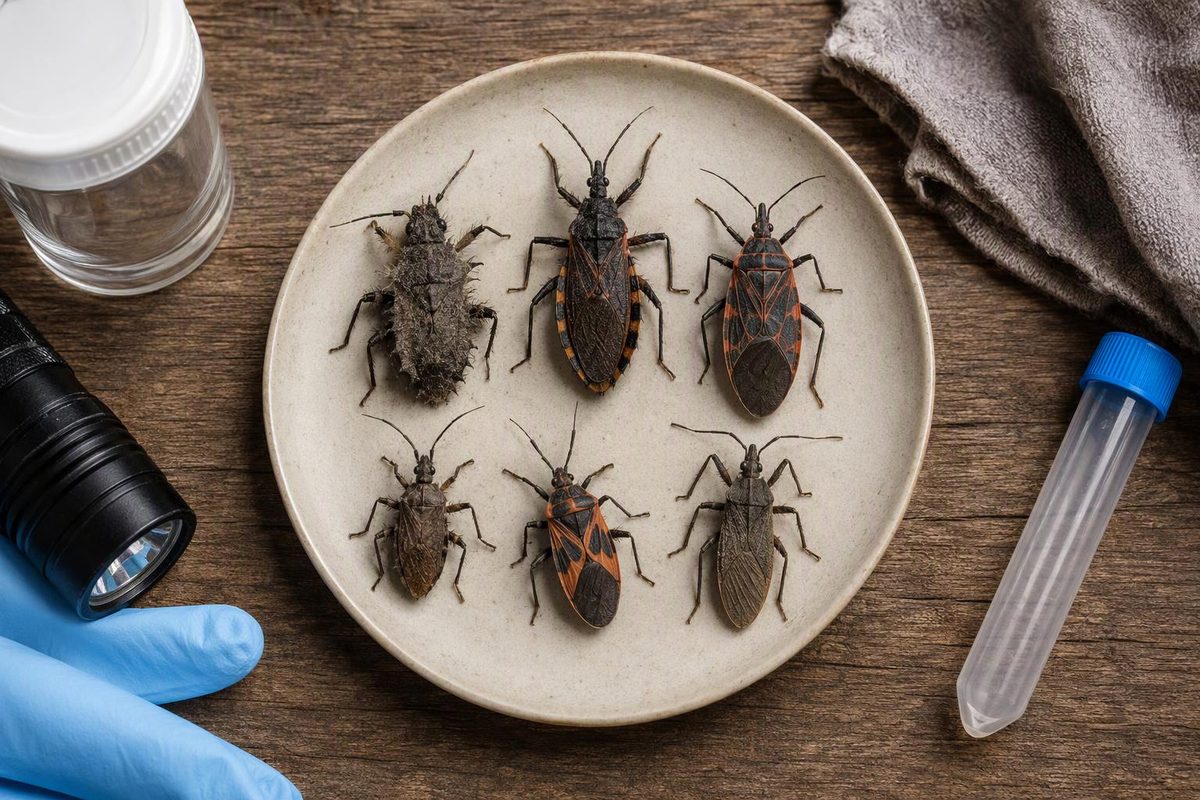
Wheel bugs, boxelder bugs, western conifer seed bugs and masked hunters can all be mistaken for kissing bugs. Check the insect’s shape and markings together—not just its color, where you found it or a suspected bite. If the identification remains uncertain, keep a specimen safely contained and get identification help before choosing a treatment.
What a kissing bug looks like in the U.S.
For kissing bugs found in the United States, Texas A&M’s identification guidance describes these features:
- Size: adults are about ½–1 inch long, measured from the tip of the head to the end of the body.
- Legs: long and thin, without widened, leaf-like sections.
- Abdomen: most species have alternating orange or red markings around the outer edge.
- Mouthparts: a slender, straight beak, usually tucked beneath the body.
The elongated, cone-shaped head is another clue. The University of Maryland Extension guide describes that head shape and shows the eastern bloodsucking conenose bug with a dark, flattened body and orange-red markings along the abdomen outside the wing margins.
These are clues, not a universal color test. Texas A&M notes that the western species Triatoma protracta may have a single light-brown border rather than red-orange stripes. Young kissing bugs have no wings and are smaller than adults. Missing bright stripes or adult wings does not settle the identification. Do not handle or flip a loose insect to inspect its mouthparts.
Common look-alikes and the useful differences
The linked university guides include photographs for comparison. The features below are most useful for intact adults; juveniles or damaged specimens may need expert identification.
| Possible look-alike | What to check | What the finding means |
|---|---|---|
| Wheel bug | A conspicuous raised, wheel-shaped crest on its back. | This is a predatory assassin bug, not a kissing bug. Red-orange abdominal markings alone can mislead. See Maryland Extension’s comparison. |
| Boxelder bug | Red lines along the edges of the front wings, rather than the series of red-orange markings along the exposed abdomen seen in the eastern kissing bug. | Red-and-black coloring is not enough to identify a kissing bug. See the boxelder comparison. |
| Western conifer seed bug | Leaf-like expansions on the hind legs; often a thin, jagged pale line across the back, though that line can be dark or absent. | This is a plant-feeding bug that commonly enters buildings for winter shelter. See Penn State’s illustrated guide. |
| Masked hunter | Adults are dark brown or black and about ¾ inch long. Young insects camouflage themselves with dust and lint. | Adult size and color overlap with kissing bugs: get identification help if this is a close match. Masked hunters eat other insects and can bite painfully if handled. See Michigan State’s guide. |
Kissing bugs themselves belong to the assassin-bug family, so “assassin bug” is not a sufficiently specific identification. Colorado State Extension explains that insect-eating assassin bugs can share the elongated head and beak of kissing bugs. A look-alike is not necessarily safe to pick up.
If you still suspect a kissing bug
Stop bare-hand handling and hold off on insecticide treatment. Texas A&M recommends using a glove or a small plastic bag as a barrier when collecting the insect, then keeping it in a closed bag, vial or other small container.
- Photograph it without direct contact. Aim for a clear view of the whole insect, including its head, abdominal edges and legs. Include a ruler beside the closed container if practical.
- Record the circumstances. Note the date, time, location, whether it was indoors or outdoors, and any possible bites on people or animals.
- Request identification. Texas A&M accepts photos of suspected kissing bugs; its FAQ explains how to submit them. A local university extension office is another place to ask about identification services. Ask the receiving service for instructions before mailing a specimen.
- Escalate possible exposure separately. If you think the insect bit someone, or you are worried about a bite, contact a healthcare provider. Do not wait for an insect-identification reply to address a health concern.
A bite mark cannot reliably identify the insect: Texas A&M reports no typical kissing-bug bite reaction. Finding a kissing bug also does not establish infection. The Chagas parasite is associated with infected bug feces, not injected through the bite; CDC says diagnosis requires a healthcare provider and laboratory testing.
What to check around the house
While identification is pending, inspect door and window gaps and damaged screens. CDC’s home-prevention guidance recommends repairing screens and sealing entry gaps to reduce contact with kissing bugs.
If kissing bugs are confirmed or keep appearing indoors, ask a pest-control professional to assess entry points and control options. CDC advises consulting a pest-control expert before using insecticides against them. An uncertain insect identification is not a sound basis for choosing a spray.